Monday, March 13, 2006

Censure George W. Bush

The unprecedented power grab by President Bush, in blatently breaking the FISA law and lying about it, must be stopped by Congress. I challenge my "anything Bush wants in the (permanent) War Against Terrorism" friends to tell me where Senator Feingold is wrong. I don't see it. Either the law applies to all or it doesn't. If it doesn't apply to Bush, then Bush has succeeded where Bin Laden failed: He will have destroyed American liberty.

Remarks of Senator Russ Feingold
Introducing a Resolution to Censure
President George W. Bush


As Prepared

March 13, 2006

Mr. President, when the President of the United States breaks the law, he must be held accountable. That is why today I am introducing a resolution to censure President George W. Bush.

The President authorized an illegal program to spy on American citizens on American soil, and then misled Congress and the public about the existence and legality of that program. It is up to this body to reaffirm the rule of law by condemning the President’s actions.

All of us in this body took an oath to support and defend the Constitution of the United States and bear true allegiance to the same. Fulfilling that oath requires us to speak clearly and forcefully when the President violates the law. This resolution allows us to send a clear message that the President’s conduct was wrong.

And we must do that. The President’s actions demand a formal judgment from Congress.

At moments in our history like this, we are reminded why the founders balanced the powers of the different branches of government so carefully in the Constitution. At the very heart of our system of government lies the recognition that some leaders will do wrong, and that others in the government will then bear the responsibility to do right.

"This President has done wrong. This body can do right by condemning his conduct and showing the people of this nation that his actions will not be allowed to stand unchallenged."

This President has done wrong. This body can do right by condemning his conduct and showing the people of this nation that his actions will not be allowed to stand unchallenged.

To date, members of Congress have responded in very different ways to the President’s conduct. Some are responding by defending his conduct, ceding him the power he claims, and even seeking to grant him expanded statutory authorization powers to make his conduct legal. While we know he is breaking the law, we do not know the details of what the President has authorized or whether there is any need to change the law to allow it, yet some want to give him carte blanche to continue his illegal conduct. To approve the President’s actions now, without demanding a full inquiry into this program, a detailed explanation for why the President authorized it, and accountability for his illegal actions, would be irresponsible. It would be to abandon the duty of the legislative branch under our constitutional system of separation of powers while the President recklessly grabs for power and ignores the rule of law.

Others in Congress have taken important steps to check the President. Senator Specter has held hearings on the wiretapping program in the Judiciary Committee. He has even suggested that Congress may need to use the power of the purse in order to get some answers out of the Administration. And Senator Byrd has proposed that Congress establish an independent commission to investigate this program.

As we move forward, Congress will need to consider a range of possible actions, including investigations, independent commissions, legislation, or even impeachment. But, at a minimum, Congress should censure a president who has so plainly broken the law.

Our founders anticipated that these kinds of abuses would occur. Federalist Number 51 speaks of the Constitution’s system of checks and balances:

“It may be a reflection on human nature, that such devices should be necessary to control the abuses of government. But what is government itself, but the greatest of all reflections on human nature? If men were angels, no government would be necessary. If angels were to govern men, neither external nor internal controls on government would be necessary. In framing a government which is to be administered by men over men, the great difficulty lies in this: you must first enable the government to control the governed; and in the next place oblige it to control itself.”

"...we are faced with an executive branch that places itself above the law. "

Mr. President, we are faced with an executive branch that places itself above the law. The founders understood that the branches must check each other to control abuses of government power. The president’s actions are such an abuse, Mr. President. His actions must be checked, and he should be censured.

This President exploited the climate of anxiety after September 11, 2001, both to push for overly intrusive powers in the Patriot Act, and to take us into a war in Iraq that has been a tragic diversion from the critical fight against al Qaeda and its affiliates. In both of those instances, however, Congress gave its approval to the President’s actions, however mistaken that approval may have been.

That was not the case with the illegal domestic wiretapping program authorized by the President shortly after September 11th. The President violated the law, ignored the Constitution and the other two branches of government, and disregarded the rights and freedoms upon which our country was founded. No one questions whether the government should wiretap suspected terrorists. Of course we should, and we can under current law. If there were a demonstrated need to change that law, Congress could consider that step. But instead the President is refusing to follow that law while offering the flimsiest of arguments to justify his misconduct. He must be held accountable for his actions.

The facts are straightforward: Congress passed the Foreign Intelligence Surveillance Act, known as “FISA”, nearly 30 years ago to ensure that as we wiretap suspected terrorists and spies, we also protect innocent Americans from unjustified government intrusion. FISA makes it a crime to wiretap Americans on U.S. soil without the requisite warrants, and the President has ordered warrantless wiretaps of Americans on U.S. soil. The President has broken that law, and that alone is unacceptable. But the President did much more than that.

"Not only did the President break the law, he also actively misled Congress and the American people about his actions..."

Not only did the President break the law, he also actively misled Congress and the American people about his actions, and then, when the program was made public, about the legality of the NSA program.

He has fundamentally violated the trust of the American people.

The President’s own words show just how seriously he has violated that trust.

We now know that the NSA wiretapping program began not long after September 11th. Before the existence of this program was revealed, the President went out of his way in several speeches to assure the public that the government was getting court orders to wiretap Americans in the United States – something that he now admits was not the case.

On April 20, 2004, for example, the President told an audience in Buffalo that: “Any time you hear the United States government talking about wiretap, it requires – a wiretap requires a court order. Nothing has changed, by the way.”

In fact, a lot had changed, but the President wasn’t being upfront with the American people.

Just months later, on July 14, 2004, in my own state of Wisconsin, the President said that: “Any action that takes place by law enforcement requires a court order. In other words, the government can't move on wiretaps or roving wiretaps without getting a court order.”

Last summer, on June 9, 2005, the President spoke in Columbus, Ohio, and again insisted that his administration was abiding by the laws governing wiretaps. “Law enforcement officers need a federal judge's permission to wiretap a foreign terrorist's phone, a federal judge's permission to track his calls, or a federal judge's permission to search his property. Officers must meet strict standards to use any of these tools. And these standards are fully consistent with the Constitution of the U.S.”

In all of these cases, the President knew he wasn’t telling the complete story. But engaged in tough political battle during the presidential campaign, and later over Patriot Act reauthorization, he wanted to convince the public that a systems of checks and balances was in place to protect innocent people from government snooping. He knew when he gave those reassurances that he had authorized the NSA to bypass the very system of checks and balances that he was using as a shield against criticisms of the Patriot Act and his Administration’s performance.

This conduct is unacceptable. The President had a duty to play it straight with the American people. But for political purposes, he ignored that duty.

After a New York Times story exposed the NSA program in December of last year, the White House launched an intensive effort to mislead the American people yet again. No one would come to testify before Congress until February, but the President’s surrogates held press conferences and made speeches to try to convince the public that he had acted lawfully.

"...the President himself participated in this disinformation campaign."

Most troubling of all, the President himself participated in this disinformation campaign. In the State of the Union address, he implied that the program was necessary because otherwise the government would be unable to wiretap terrorists at all. That is simply untrue. In fact, nothing could be further from the truth. You don’t need a warrant to wiretap terrorists overseas – period. You do need a warrant to wiretap Americans on American soil and Congress passed FISA specifically to lay out the rules for these types of domestic wiretaps.

FISA created a secret court, made up of judges who develop national security expertise, to issue warrants for surveillance of suspected terrorists and spies. These are the judges from whom the Bush Administration has obtained thousands of warrants since 9/11. They are the judges who review applications for business records orders and wiretapping authority under the Patriot Act. The Administration has almost never had a warrant request rejected by those judges. It has used the FISA Court thousands of times, but at the same time it asserts that FISA is an “old law” or “out of date” in this age of terrorism and can’t be complied with. Clearly, the Administration can and does comply with it – except when it doesn’t. Then it just arbitrarily decides to go around these judges, and around the law.

The Administration has said that it ignored FISA because it takes too long to get a warrant under that law. But we know that in an emergency, where the Attorney General believes that surveillance must begin before a court order can be obtained, FISA permits the wiretap to be executed immediately as long as the government goes to the court within 72 hours. The Attorney General has complained that the emergency provision does not give him enough flexibility, he has complained that getting a FISA application together or getting the necessary approvals takes too long. But the problems he has cited are bureaucratic barriers that the executive branch put in place, and could remove if it wanted.

FISA also permits the Attorney General to authorize unlimited warrantless electronic surveillance in the United States during the 15 days following a declaration of war, to allow time to consider any amendments to FISA required by a wartime emergency. That is the time period that Congress specified. Yet the President thinks that he can do this indefinitely.

The President has argued that Congress gave him authority to wiretap Americans on U.S. soil without a warrant when it passed the Authorization for Use of Military Force after September 11, 2001. Mr. President, that is ridiculous. Members of Congress did not pass this resolution to give the President blanket authority to order warrantless wiretaps. We all know that. Anyone in this body who would tell you otherwise either wasn’t here at the time or isn’t telling the truth. We authorized the President to use military force in Afghanistan, a necessary and justified response to September 11. We did not authorize him to wiretap American citizens on American soil without going through the process that was set up nearly three decades ago precisely to facilitate the domestic surveillance of terrorists – with the approval of a judge. That is why both Republicans and Democrats have questioned this theory.

"It is ridiculous to think that Congress would have negotiated and enacted all the changes to FISA in the Patriot Act if it thought it had just authorized the President to ignore FISA in the AUMF."

This particular claim is further undermined by congressional approval of the Patriot Act just a few weeks after we passed the Authorization for the Use of Military Force. The Patriot Act made it easier for law enforcement to conduct surveillance on suspected terrorists and spies, while maintaining FISA’s baseline requirement of judicial approval for wiretaps of Americans in the U.S. It is ridiculous to think that Congress would have negotiated and enacted all the changes to FISA in the Patriot Act if it thought it had just authorized the President to ignore FISA in the AUMF.

In addition, in the intelligence authorization bill passed in December 2001, we extended the emergency authority in FISA, at the Administration’s request, from 24 to 72 hours. Why do that if the President has the power to ignore FISA? That makes no sense at all.

The President has also said that his inherent executive power gives him the power to approve this program. But here the President is acting in direct violation of a criminal statute. That means his power is, as Justice Jackson said in the steel seizure cases half a century ago, “at its lowest ebb.” A letter from a group of law professors and former executive branch officials points out that “every time the Supreme Court has confronted a statute limiting the Commander-in-Chief’s authority, it has upheld the statute.” The Senate reports issued when FISA was enacted confirm the understanding that FISA overrode any pre-existing inherent authority of the President. As the 1978 Senate Judiciary Committee report stated, FISA “recognizes no inherent power of the president in this area.” And “Congress has declared that this statute, not any claimed presidential power, controls.” Contrary to what the President told the country in the State of the Union, no court has ever approved warrantless surveillance in violation of FISA.

The President’s claims of inherent executive authority, and his assertions that the courts have approved this type of activity, are baseless.

But it is one thing to make a legal argument that has no real support in the law. It is much worse to do what the President has done, which is to make misleading statements about what prior Presidents have done and what courts have approved, to try to make the public believe his legal arguments are much stronger than they are.

For example, in the State of the Union, the President argued that federal courts have approved the use of presidential authority that he was invoking. I asked the Attorney General about this when he came before the Judiciary Committee, and he could point me to no court – not the Supreme Court or any other court – that has considered whether, after FISA was enacted, the President nonetheless had the authority to bypass it and authorize warrantless wiretaps. Not one court. The Administration’s effort to find support for what it has done in snippets of other court decisions would be laughable if this issue were not so serious.

In the same speech, the President referred to other Presidents in American history who cited executive authority to order warrantless surveillance. But of course, those past presidents – like Wilson and Roosevelt – were acting before the Supreme Court decided in 1967 that our communications are protected by the Fourth Amendment, and before Congress decided in 1978 that the executive branch could no longer unilaterally decide which Americans to wiretap. I asked the Attorney General about this issue when he testified before the Judiciary Committee. And neither he nor anyone in the Administration has been able to come up with a single prior example of wiretapping inside the United States since 1978 that was conducted outside FISA’s authorization.

So the President’s arguments in the State of the Union were baseless, and it is unacceptable that the President of the United States would so obviously mislead the Congress and American public.

The President also has argued that periodic internal executive branch review provides an adequate check on the program. He has even characterized this periodic review as a safeguard for civil liberties. But we don’t know what this check involves. And we do know that Congress explicitly rejected this idea of unilateral executive decision-making in this area when it passed FISA.

Finally, the President has tried to claim that informing a handful of congressional leaders, the so-called Gang of Eight, somehow excuses breaking the law. Of course, several of these members said they weren’t given the full story. And all of them were prohibited from discussing what they were told. So the fact that they were informed under these extraordinary circumstances does not constitute congressional oversight, and it most certainly does not constitute congressional approval of the program.

Indeed, it doesn’t even comply with the National Security Act, which requires the entire memberships of the House and Senate Intelligence Committee to be “fully and currently informed of the intelligence activities of the United States.” Nor does the latest agreement to allow a seven-member subcommittee to review the program comply with the law. Granting a minority of the committee access to information is inadequate and still does not comply with the law requiring that the full committee be kept fully informed.

In addition, we now know that some of the Gang of Eight expressed concern about the program. The Administration ignored their protests. One of the eight members of Congress who has been briefed about the program, Congresswoman Jane Harman, ranking member of the House Intelligence Committee, has said she sees no reason why the Administration cannot accomplish its goals within the law as currently written.

None of the President’s arguments explains or excuses his conduct, or the NSA’s domestic spying program. Not one. It is hard to believe that the President has the audacity to claim that they do.

"He essentially argues that the American people should trust him simply because of the office he holds."

And perhaps that is what is most troubling here, Mr. President. Even more troubling than the arguments the President has made is what he relies on to make them convincing – the credibility of the office of the President itself. He essentially argues that the American people should trust him simply because of the office he holds.

But Presidents don’t serve our country by just asking for trust, they must earn that trust, and they must tell the truth.

This President hides behind flawed legal arguments, and even behind the office he holds, but he cannot hide from what he has created: nothing short of a constitutional crisis. The President has violated the law, and Congress must respond. Congress must investigate and demand answers. Congress should also determine whether current law is inadequate and address that deficiency if it is demonstrated. But before doing so, Congress should ensure that there is accountability for authorizing illegal conduct.

A formal censure by Congress is an appropriate and responsible first step to assure the public that when the President thinks he can violate the law without consequences, Congress has the will to hold him accountable. If Congress does not reaffirm the rule of law, we will create another failure of leadership, and deal another blow to the public’s trust.

"We in the Congress bear the responsibility to check a President who has violated the law, who continues to violate the law, and who has not been held accountable for his actions."

The President’s wrongdoing demands a response. And not just a response that prevents wrongdoing in the future, but a response that passes judgment on what has happened. We in the Congress bear the responsibility to check a President who has violated the law, who continues to violate the law, and who has not been held accountable for his actions.

Passing a resolution to censure the President is a way to hold this President accountable. A resolution of censure is a time-honored means for the Congress to express the most serious disapproval possible, short of impeachment, of the Executive’s conduct. It is different than passing a law to make clear that certain conduct is impermissible or to cut off funding for certain activities. Both of those alternatives are ways for Congress to affect future action. But when the President acts illegally, he should be formally rebuked. He should be censured.

The founders anticipated abuses of executive power by creating a balance of powers in the Constitution. Supporting and defending the Constitution, as we have taken an oath to do, require us to preserve that balance, and to have the will to act. We must meet a serious transgression by the President with a serious response. We must work, as the founders urged us in Federalist Number 51, to control the abuses of government.

The Constitution looks to the Congress to right the balance of power. The American people look to us to take action, to speak out, with one clear voice, against wrongdoing by the President of the United States. In our system of government, no one, not even the President, is above the law.

Mr. President, I ask unanimous consent that the text of the resolution be printed in the Record following my remarks. I yield the floor.

"In our system of government, no one, not even the President, is above the law."

Sunday, March 12, 2006

Sunday Update - Terrell & Sheila MM

2.4 miles today along the Levee and Broad Street. 31.2 miles for the month.

It does feel good to be keeping up with our big goal for the month, Carol. I hope we can keep the pace. We've been lucky in fantastic weather... global warming gives us good walking weather in Rome, I guess. :-) We were considering turning on the A/C today. It's hot!

Let's hear from everybody... keep going for the marathon!

Saturday, March 11, 2006

My feet hurt! MM

We skipped Thursday because of rain and Friday because Lillian's literary meet, a resulting shopping trip and laziness. So we decided to have a nice long walk in the springlike weather of early afternoon today. First we took Daisy for a one mile stroll. Then we walked down the levee to Fifth, across and over to Ridge Ferry Park via the Riverwalk. We discovered the walk has been extended behind Chieftains Museum so we explored it all the way to State Mutual Stadium - 3 miles out and 3 back, for a grand total of seven miles for the afternoon, and sore feet. Gorgeous walk among the mamas and daddys and kids, elderly couples, young lovers, friends, and individuals on foot, on bikes and in kayaks.

21.8 plus seven miles today put us past the old marathon mark for this month, already. 28.8!
And all of it together! It's been great spending this time with Sheila - though we've put off some other things so we can walk. Maybe we'll make one of those outlandish goals I set for this month.

Wednesday, March 08, 2006

Tues/Wed Report - Terrell & Sheila MM

2.5 miles on Broad St & environs on Tuesday. Sheila wasn't feeling well - she stayed out of work - so I was glad we got in as much as we did. Tonight we took the levee to Heritage Park, the footbridge to Broad St. Up First Ave. three blocks, over to Second Ave, back to Broad, dinner at the Harvest Moon Cafe, then back our usual path - 3.2 miles.

Total for the month: 21.8 miles.

The Right Wing Goes Bonkers Again

Take a Deep Breath
Several bloggers have come unhinged about a teacher in Colorado leading a very provocative discussion of world politics. I know nothing about Mr. Bennish except what I have read in the blogs. The guy makes several good points and he seemed polite toward those of opposing views. Were his tone not a little frantic occasionally, I would have little problem with his lesson. BTW when some of the teachers at my daughters' high school have ranted about President Clinton I ridiculed them to my daughters, true, but I didn't try to get them fired. One blogger found the teacher's comments "a screeching diatribe". This blogger says he "... taught communism and anti-Bush, anti-America thinking...". I do not know how this blogger reached these conclusions. I listened to the tape. It seemed strongly worded, occasionally too shrill, but always polite and open to opposing opinions, certainly not a "screeching diatribe". Suggesting that unbridled capitalism is not a panacea for poverty is not "teaching communism" - if it were then we would have to re-label Teddy Roosevelt and blast some rock off the side of a big hill in South Dakota. Does the writer find "anti-Bush" and "anti-American" synonymous. According to most current polls over 60% of Americans themselves would be anti-American by that definition. The fact is, as this young teacher made clear, there are huge differences in Bush and and a certain mass murderer/dictator, but also some "...eerie similarities to the tone they both use...". I wish Bennish had avoided the incendiary comparison and used a more generic one. He presented the Fox "News" folks and the right wing blogs a way to cloud the issue. This week Sandra Day O'Connor said virtually the same thing about the Delay wing of the GOP but did it more gently. According to Justice O'Connor (criticizing the Republican attack on judicial independence) [See DailyKos]
"It takes a lot of degeneration before a country falls into dictatorship, but we should avoid these ends by avoiding these beginnings."
Some bloggers on the right have become so shrill in their frightened screeds concerning terrorism and Islam that you could not slip an onion skin between some of their rhetoric in regard to Islam and a Nazi's in regard to Judaism. A few are so frightened by the radical Islamics that they are ready to forsake all morals, ethics, and wisdom and wipe Islam from the earth. The time to make the dictator comparisons is not after the guy takes power, it is in the early stages of "degeneration". The current situation makes you realize how a you-know-who could succeed by playing on the fears of the Germans in the thirties and forties. Having taught a number of Islamic kids over the last several years, I worry about their treatment in a community where even some educated, church-going folk are so fearful of Islamic people they countenance suspending the Bill of Rights for them. I am not a Muslim. I do not believe Mohammed was a prophet. I find, obviously, mainstream Islamic beliefs unbelievable. I find radical Islamic beliefs laughable, superstitious, and barbaric. I am not a Catholic. I believe Joseph Ratzinger is just another guy. He ain't my pope. He's not my "Holiness". I believe he'd have a sunnier disposition if he had married and multiplied. I find much of orthodox Catholic belief unbelievable. I find the beliefs of some Catholics laughable, superstitious, and barbaric. I am a Methodist. I have found a belief system in mainstream Methodism that I can embrace, but I find some radical Methodists and some other radical Protestants, laughable, superstitious, and barbaric. All kinds of radicals are scary, of course. But I will not allow them to scare me into compromising basic American principles. The discussion that has the frantic right-wing blogosphere in such a dither represented 20 minutes out of, I suppose, a fifty minute high school world geography class on the day after the State of the Union address. Sounds like a natural discussion for that class on that day to me. Since all I know about this teacher is what you will read below, I'm not gonna go too far out on my limb for Mr. Bennish. He probably goes over the line a little, in tone at least, but the excerpt I read and listened to did not seem worthy of the reaction of the frightened right-wing. One commenter on the DailyKos quoted a church marquee:
The truth doesn't hurt unless it should.
Several points Bennish makes raise questions that deserve to be dispassionately discussed by thinking people in America. Here are my discussion questions:
  • Is unbridled free enterprise an absolute good?
  • Does "preemptive war" undermine our position when we deal with, for example, a democratically-elected Hamas that wants to destroy a government that they think was forced undemocratically upon Palestinians?
  • If we can use violence to impose our view of what is right on other nations, why can they not feel justified in doing the same to us?
Any way, Bennish's words having been, in my opinion, badly interpreted by the right-wing bloggers. I think it is worthwhile to read the actual words (as quoted on a right wing blog). I have added my comments in red.
__________
Bennish: Why do we have troops in Colombia fighting in their civil war for over 30 years. Most Americans don't even know this. For over 30 years, America has had soldiers fighting in Colombia in a civil war. Why are we fumigating coca crops in Bolivia and Peru if we're not trying to control other parts of the world. Who buys cocaine? Not Bolivians. Not Peruvians. Americans! Ok. Why are we destroying the farmers' lives when we're the ones that consume that good. Can you imagine? What is the world's number one single cause of death by a drug? What drug is responsible for the most deaths in the world? Cigarettes! Who is the world's largest producer of cigarettes and tobacco? The United States! What part of our country grows all our tobacco? Anyone know what states in particular? Mostly what's called North Carolina. Alright. That's where all the cigarette capitals are. That's where a lot of them are located from. Now if we have the right to fly to Bolivia or Peru and drop chemical weapons on top of farmers' fields because we're afraid they might be growing coca and that could be turned into cocaine and sold to us, well then don't the Peruvians and the Iranians and the Chinese have the right to invade America and drop chemical weapons over North Carolina to destroy the tobacco plants that are killing millions and millions of people in their countries every year and causing them billions of dollars in health care costs? [I have not studied this issue, but given the marketing worldwide of tobacco by American companies this is a great discussion question. Whatever the teacher's real position on the topic the question challenges students to explore their real convictions and think "outside the box." Bravo.] Make sure you get these definitions down. Capitalism: If you don't understand the economic system of capitalism, you don't understand the world in which we live. Ok. Economic system in which all or most of the means of production, etc., are owned privately and operated in a somewhat competitive environment for the purpose of producing profit. Of course, you can shorten these definitions down. Make sure you get the gist of it. Do you see how when, you know, when you're looking at this definition, where does it say anything about capitalism is an economic system that will provide everyone in the world with the basic needs that they need? Is that a part of this system? Do you see how this economic system is at odds with humanity? At odds with caring and compassion? It's at odds with human rights. [I believe that communism is a failed governmental system and socialism is a failed economic system. Of course pure democracy is impractical and unbridled capitalism is oligarchy of the rich. The US has somewhat balanced the need for incentive and freedom in the economic life of the country with support for the weak and underprivileged. There is certainly nothing particularly Christian about free enterprise or particularly unChristian about socialism.] Anytime you have a system that is designed to procure profit, when profit is the bottom motive -- money -- that means money is going to become more important potentially than what? Safety, human lives, etc. Why did we invade Iraq?! How do we know that the invasion of Iraq for weapons of mass destruction-- even if weapons had been found, how would you have known, how could you prove--that that was not a real reason for us to go there. There are dozens upon dozens of countries that have weapons of mass destruction. Iraq is one of dozens. There are plenty of countries that are controlled by dictators, where people have no freedom, where they have weapons of mass destruction and they could be potentially threatening to America. We're not invading any of those countries. [Awkwardly stated but true.] ------ I'll give you guys another minute or two to get some of these [definitions] down. I agree with Joey. Try to condense these a little bit. I took these straight out of the dictionary. Anyone in here watch any of Mr. Bush's speech last night? I'm gonna talk a little about some of things he had to say. ------- One of things that I'll bring up now, since some of you are still writing, is, you know, Condoleezza Rice said this the other day and George Bush reiterated it last night. And the implication was that the solution to the violence in the Middle East is democratization. And the implication through his language was that democracies don't go to war. Democracies aren't violent. Democracies won't want weapons of mass destruction. This is called blind, naive faith in democracy. ------- Who is probably the single most violent nation on planet Earth? Unidentified student: We are. [We have, as far as I know, the highest murder rate in the industrialized world, by far. The following is from President Carter's book, Our Endangered Values: America's Moral Crisis: "The Johns Hopkins Center for Gun Policy and Research reports that the rate of firearm homicide in the United States is nineteen times higher than that of 35 other high-income countries combined. In the most recent year for which data are available, handguns killed 334 people in Australia, 197 in Great Britain, 183 in Sweden, 83 in Japan, 54 in Ireland, 1,034 in Canada, and 30,419 in the United States." ] The United States of America. And we're a democracy. Quote-unquote. Who has the most weapons of mass destruction in the world? The United States. Who's continuing to develop new weapons of mass destruction as we speak? The United States. [Undeniably true. ] So, why does Mr. Bush think that other countries that are democracies won't wanna be like us? Why does he think they'll just wanna be at peace with each other? What makes him think that when the Palestinians get their own state that they won't wanna preemptively invade Israel to eliminate a potential threat to their security just like we supposedly did in Iraq? Do you see the dangerous precedent that we have set by illegally invading another country and violating their sovereignty in the name of protecting us against a potential future--sorry--attack? [Unintelligible.] [If we can force our beliefs on others, why can't they force theirs on us? ] ------ Why doesn't Mexico invade Guatemala? Maybe they're scared of being attacked. Ok. Why doesn't North Korea invade South Korea? They might be afraid of being attacked. Or maybe Iran and North Korea and Saudi Arabia and what else did he add to the list last night - and Zimbabwe - maybe they're all gonna team up and try and invade us because they're afraid we might invade them. I mean, where does this cycle of violence end? You know? This whole "do as I say, not as I do" thing. That doesn't work. What was so important about President Bush's speech last night--and it doesn't matter if it was President Clinton still it would just as important -- is that it's not just a speech to America. But who? The whole world! It's very obvious that if you listen to his language, if you listen to his body language, and if you paid attention to what he was saying, he wasn't always just talking to us. He was talking to the whole planet. Addressing the whole planet. He started off his speech talking about how America should be the country that dominates the world. That we have been blessed essentially by God to have the most civilized, most advanced, best system and that it is our duty as Americans to use the military to go out into the world and make the whole world like us. ------ Sounds a lot like the things that Adolf Hitler use to say. We're the only ones who are right. Everyone else is backwards. And it's our job to conquer the world and make sure they live just like we want them to. Now, I'm not saying that Bush and Hitler are exactly the same. Obviously, they are not. Ok. But there are some eerie similarities to the tones that they use. Very, very "ethnocentric." We're right. You're all wrong. [Sounds like... is not there yet, but now's the time to nip it in the bud. This guy tried to be careful here. He would have been wise to avoid the H word. These things need to be said: maybe less passionately, maybe better phrased, but they need discussion.] I just keep waiting. You know, at some point I think America and Mexico might go to war again. You know. Anytime Mexico plays the USA in a soccer match. What can be heard chanting all game long? ------ Do all Mexicans dislike the United States? No. Do all Americans dislike Mexico? No. But there's a lot of resentment--not just in Mexico, but across the whole world--towards America right now. We told--Condoleezza Rice said--that now that Hamas got elected to lead the Palestianians that they have to renounce their desire to eliminate Israel. And then Condoleezza Rice also went on to say that you can't be for peace and support armed struggle at the same time. You can't do that. Either you're for peace or war. But you can't be for both. What is the problem with her saying this? That's the same thing we say. That is exactly the same thing this current administration says. We're gonna make the world safe by invading and killing and making war. So, if we can be for peace and for war, well, why can't the Palestinians be for peace and for war? [Again, very provocative questions. Think kids. What do you think? If we are right let's articulate it! Let's know what we are sending our kids to die for! Think it through. This is our history and it's happening now. There is real blood flowing. If it continues a few more years some of you may help fight it: all of you will help pay for it. If you're gonna support a war, you ought to be able to articulate why!] ----- Student Sean Allen, who is taping Bennish: Isn't there a difference of, of, having Hamas being like, we wanna attack Israelis because they're Israelis, and having us say we want to attack people who are known terrorists? Isn't there a difference between saying we're going to attack innocents and we're going to attack people who are not innocent? [Good point kid. You're thinking about it. Let's consider that. So... what is a terrorist?] ----- Bennish: I think that's a good point. But you have to remember who's doing the defining of a terrorist. And what is a terrorist? Allen: Well, when people attack us on our own soil and are actually attempting to take American lives and want to take American lives, whereas, Israelies in this situation, aren't saying we want to blow up Palestine... Bennish: How did Israel and the modern Israeli state even come into existence in the first place? Allen: We gave it to them. Bennish: Sort of. Why? After the Israel-Zionist movement conducted what? Terrorist acts. They assassinated the British prime minster in Palestine. They blew up buildings. They stole military equipment. Assassinated hundreds of people. Car bombings, you name it. That's how the modern state of Israel was made. Was through violence and terrorism. Eventually we did allow them to have the land. Why? Not because we really care, but because we wanted a strategic ally. We saw a way to us to get a hook into the Middle East. [One man's terrorist is sometimes another man's freedom fighter. I live within half a mile of the former homes of two major Cherokee chiefs and a mile from the site of an ancient Mississippian burial mound. What if American Indians were to decide my house sits on their "promised land"? When they wrest my property from me how will I respond? Might I get a little violent? I don't oppose the Israelis but I'm not blind to the sometimes justifiable upset on the Palestianian side.] If we create a modern nation of Israel, then, and we make them dependent on us for military aid and financial aid, then we can control a part of the Middle East. We will have a country in the Middle East that will be indebted to us. Allen: But is it ok to say it's just to attack Israel? If it's ok to attack known terrorists, it's ok to attack Israel? Bennish: If you were Palestinians, who are the real terrorists? The Israelis, who fire missiles that they purchased from the United States government into Palestinian neighborhoods and refugees and maybe kill a terrorist, but also kill innocent women and children. And when you shoot a missile into Pakistan to quote-unquote kill a known terrorist, and we just killed 75 people that have nothing to do with al Qaeda, as far as they're concerned, we're the terrorists. We've attacked them on their soil with the intention of killing their innocent people. [More good points to consider that apply as well to Iraq. ] ----- Allen: But we did not have the intention of killing innocent people. We had the intention of killing an al Qaeda terrorist. [The road to hell is paved with good intentions, according to a reliable source.] Bennish: Do you know that? Allen: So, you're saying the United States has intentions to kill innocent people? Bennish: I don't know the answer to that question. Allen: But what gain do we get from killing innocent people in the Middle East? What gain does that pose to us? Bennish: Let me ask you this. During the 1980s, Iran and Iraq were involved in an 8-year-long war. The United States sold missiles, tanks, guns, planes, to which side? Unidentified student: Iraq? Bennish: Both. The answer is both. Why would we send armaments to two sides that are fighting each other. That seems to be self-defeating. Don't we want one side to win? Not always! Sometimes you just want there to be conflict! [It seems to me this guy is using pretty good Socratic method - to a point. Excellent questions for this discussion. He just needs to pose the questions, but draw more students into the discussion. ] The British -- this is one of the grand strategies of the British imperial system--was to play local animosities off each other. To prevent them is to divide and conquer. Do we really want the Middle East to unite as one cohesive political and cultural body? No! Because then they could what? Threaten our supremacy. We want to keep the world divided. Do we really want to kill innocent people? I don't know. I don't know the answer to that. I know there are some Americans who do. People who work in the CIA. People who have to think like that. Those kind of dirty minds, dirty tricks. That's how the intelligence world works. Sometimes you do want to kill people just for the sake of killing them. Right? Listen, between the years 1960 and 1962, the United States through the CIA conducted over 7,000 terrorist sabotage attacks against the small island nation of Cuba. Over 7,000 terrorist attacks were waged against just one little country called Cuba in a two year period, intentionally, let me rephrase that, intentionally blowing up medical supplies, intentionally burning down crops that feed their country, thereby creating starvation, right? Intentionally trying to make that system collapse. And we're willing to expend however many thousands of people died because we just want to get rid of Castro. And the sad reality is that there are some policy planners who are willing to let people die in order to achieve their objectives. [Again, war is sometimes necessary. But in a democracy we should KNOW why we're fighting and we should have the support of the nation or stay out of the fight.] ----- Now, do I think President Bush says 'I'd like to go kill some innocent Palestianians?' I don't think he thinks like that. But I also know that he's not the only one making decisions. I also know that after September 11, President Bush got on TV and he said, 'You will feel our wrath. You will feel the full force of the United States military. There will be paybacks.' He said it again last night. He said, 'We've killed a lot of top-ranking al Qaeda members. And for those who aren't killed yet, you're day will come!' Right? That kind of language to me is very obvious. ------ And when you go trying to kill one particular type of person, you know that you're gonna kill other people, too. And let me ask you this... Allen: Later in that, he stated that he's [Osama bin Laden] trying to kill innocents... Bennish: I understand that, but hold on, you have to understand something, that when al Qaeda attacked America on September 11, in their view, they're not attacking innocent people. Ok. The CIA has an office at the World Trade Center. The Pentagon is a military target. The White House was a military target. Congress is a military target. The World Trade Center is the economic center of our entire economy. [Americans need to know the truth about the attacks. The simplistic mottos of Bush and his right-wing supporters do not inform the topic. Why are these men willing to die to kill us? ] ----- The FBI, who tracks down terrorists and so on and so forth around the world, has offices in the World Trade Center. Some of the companies that work in the World Trade Center are these huge multinational corporations that are directly involved in the military-industrial complex in supporting corrupt dictatorships in the Middle East. And so in the minds of al Qaeda, they're not attacking innocent people. They're attacking legitimate targets. People who have blood on their hands as far as they're concerned. We portray them as innocent because they're our friends and neighbors, family, loved ones. One of my best friends from high school, elementary school, and birth, lives in lower Manhattan. You know, he was right there, he was four blocks away from it. So, anytime it comes close to home, you begin to see things differently. ----- In no way am I implying, I don't know, you got to figure this stuff out for yourself, but I want you to think about these things--you know, think about this right here. Here's the real homeland security. Fighting terrorism since 1492! Ok. I mean, to many Native Americans, that flag is no different than the Nazi flag or the Confederate flag. It represents the people that came and stole their land, lied, brought disease, rape, pillage, destruction, etc. So it all depends upon varying people's perspectives varying. And of course, we're going to see ourselves as being in the right , at least the majority of us, because that's us. Allen: But we were the ones that were attacked first. On September 11, 2001, we were the ones that were attacked. We were not attacking anybody until that point. Then we said ok, we're going into Afghanistan. Then we said ok, the Iraqi government has ties with al Qaeda. We're going to go into Iraq. We were the ones that were attacked. Bennish: In actuality, if you remember back to my first day, the Sept. 11 attacks were, according to bin Laden, a direct response to our 1) support of the nation of Israel, which they consider to be a terrorist regime that does not have the right to control the land that the Palestinians lived on for over 1,500 years, and they also did it because of what George Clinton did--Bill Clinton, not George Clinton, they had a little documentary on him on PBS last night I was watching--Bill Clinton, when he launched the missile attacks into Afghanistan and Sudan and killed thousands of innocent Africans and Afghanistan people - Afghanis - that had nothing to do with al Qaeda or anything. In fact, in Sudan, he blew up the country's largest pharmaceutical plant, which was producing medicines, alright, um, you know, that's as far as, in their eyes, that was retaliation for those attacks. And so this whole idea of who attacked who first, how far back in time do you wanna go!? This is the whole thing with the Arab-Israeli conflict. Well, who was there first? Well, if you believe the Bible, you say, well, God gave the land of Canaan to the Israelites. But who was in that land when they got there? The Canaanites, who some archeologists would argue are the ancient descendants of the Palestinians. You know. Other archeologists say the Hebrews didn't really come from Egypt. They were actually a group of Canaanites who decided they didn't like the other Canaanites and developed this story afterward to justify how they killed all their neighbors and took over the land. --- Alright, and so this becomes very, very muddled. And I'm not in any way implying that you should agree with me. I don't even know if I'm necessarily taking a position. But what I'm trying to get you to do is to think, right, about these issues more in-depth, you know, and not just take things from the surface. And I'm glad you asked all your questions, because they're very good, legitimate questions. And hopefully that allows other people to begin to think about some of those things, too.
___________
Over all it sounds to me that the teacher was sometimes serving as devil's advocate, a common discussion leader ploy, trying to provoke discussion. His own position is sometimes obvious. Sometimes he is just forcing the kids to think about the perspective of the "other side" whether or not he agreed with it. Pointing out the positions of the terrorists is not adopting their positions. It is obvious that he opposes many of Bush's positions, like most Americans. He said nothing here to indicate he is a communist. He said nothing here to indicate he is an Al Qaeda sympathizer. He said nothing here to indicate he is anti-American. Anti-Bush? Yeah. Me too.

Tuesday, March 07, 2006

Don Baird, my cuz.


Don Baird

During my teen years, pressed for conversation on a date, I would tune in 750 on the old radio dial and see if I could catch my first cousin Don broadcasting the news on WSB. Clear channel WSB can be heard just about anywhere. That was good for a little conversation about my famous cousin. What a great radio voice! I didn't really know Don that well at the time. He was older and we only saw each other at weddings, funerals, and other reunions at Mama Baird's house.

In recent years I've been able to know this guy better. Since he is an only child and both his parents are gone, my mother and I and my siblings have managed to talk him into joining our branch of the family tree more often, even joining us for some vacation time.

Don is smart, wise, gentle, unassuming, creative, and full of fascinating stories about the great interviews he has done with folks like Peter, Paul, and Mary or Lester Maddox or lots of other celebrities and politicians. He's had a spate of health problems lately. I hope he will soon feel like joining our family blog obsession and tell a few of those stories.

I ran across this website of WSB Radio history with a nice little article about Don.

Monday, March 06, 2006

Sunday/Monday report - Terrell & Sheila

I think Sheila may be committed to the Monthly Marathon now. She has accompanied me on every step of the MM this month so far. Yesterday afternoon we covered 2.5 miles on the levees. This evening we had a very nice brisk walk along Avenue A, Fifth Ave, First Street, across to Broad from the fire station, down Broad to the Etowah and back by the same route. That's 3.2 miles more.
We're up to 16.1 miles for March.

I hope the rest of the MM folks are getting out in this beautiful early Spring -- well, Spring has come to Georgia in flower and fancy if not by the calendar. The daffodils, pears, quince and forsythia are bursting out all over and some of the riverbank trees and shrubs have a fringe of tiny leaves or blooms.

Come, Spring, come!

Saturday, March 04, 2006

Saturday update - Terrell MM

Sheila and I took a midday walk in gorgeous weather today. Daisy kept us company for a mile of it, then we walked the full leghth of the levee and back. Total for today 4 miles. That's 10.4 miles fot the month.

Friday, March 03, 2006

Time Machine: Cake in the Classroom

Haley Patterson's dear friend, and Armuchee's own Julia Childs Mary Louise, came to help us cook our annual Volume Measurement is Delicious Chocolate Cake lesson. (I do not know the exact date of this picture.)


Thursday, March 02, 2006

A good Start on March - Terrell MM

Sheila and I enjoyed the gorgeous bit of spring that is visiting late winter this week by taking long walks yesterday and today. Last night, after the Ash Wednesday service, we walked down to the courthouse, up First Av to the Library then down Broad Street all the way to the Etowah and back to Fifth Ave. where we stopped for supper at El Zarape and then back down Broad and up Third St to First Methodist and back again and home. A Total of 3.2 miles.
Tonight we walked the same route with a small adjustment but the same mileage. No dinner break this time.
So March is off to a good start: 6.4 miles so far. At this rate I'd make 99.2 miles this month. Doable, right? (Ha!)

Wednesday, March 01, 2006

March 1st Report MM

March 1st Report

January - 27 miles (approx)
February - 29.5 miles
Two-month Total - 56.5

March Minimum Goal - 31 miles (At least I didn't quit!)
March Improvement Goal - 39 miles (By Gum, I improved a little!)
March Mr. Optimist Goal - 47 miles (Not too shabby!)
March Keepin'-up-with-Joan Goal - 52.4 miles (I think Ican, I think I can...)
March Starry-eyed Pie-in-the-Sky Idealist Goal - 62 miles (Whoopee, I'm Mr. Buff!! I might even run a ways, come April!)

Tuesday, February 28, 2006

Guest Post: The Costs of War

Mike Bock's Take on
the Cost of the War in Iraq

Our dear friend, Mike Bock, visited for a couple of days last week. As we talked about the tragedy of the hopeless situation in Bush's war in Iraq, Mike brought up the huge monetary cost of the war. As a result of our conversations I wrote a post called "The Cost of War". Mike wrote a long response today. I repost it here.


Thanks for the opportunity -- via your Blog -- to do my own rant. You've hit on a topic that I've been giving some thought to.

A few years ago there was much worry about national debt. I'm wondering why now -- with the national debt skyrocketing like no other time in our history -- the national debt is no longer a matter of media discussion. Why isn't this topic burning up talk radio?

Rather than making war with Iraq, how could the US have better spent $250 billion? How could such vast sums been spent to make the US safer? How could money have been spent to more effectively deal with radical Islamists? How could money have been spent be better educate the youth of the world in ways that would enhance the possibilites of future peace? How could this money have been spent to better give the dispossessed, desperate and easily radicalized a greater stake in pursuing peace? There was never a sane discussion of any possible choices as how to best spend resources. (And though I am speaking of monetary resources, of course, the most important resource is human life.) There was no sane analysis of cost/benefit ratio of spending options. Wouldn't such an analysis have made a fascinating discussion? War was given as the only option. There was really no discussion of merit of the war option as compared to other options. War -- the only option. The Military Industrial complex had its way.

But when it comes to the other two-thirds of the "axis of evil" -- N. Korea and Iran -- guess what? War is not seen as the only option, because of the obvious reason that N. Korea and Iran are simply too powerful. N. Korea and Iran are, in fact, more of a threat to the US than Iraq ever was, but, we will do everything possible to avoid war with N.Korea or Iran. We know that the consequences of war with either of these nations would be severe. And so, fearing consequences, the US will try every avenue to avoid war.

But pursuing war was argued as the answer for Iraq because Iraq was seen as weak -- an easy military win, where we could quickly boast, "mission accomplished." Isn't it telling that, under the direction of George Bush, in dealing with the weak, war is the only option, but in dealing with the strong, war is avoided. Isn't this how schoolyard bullies behave? Is it any wonder that the US, throughout the world, is more and more perceived as a bully?

Our choosing war in Iraq, I would like to believe, is an aberration, not truly reflective of our national character. Choosing war in Iraq, it seems to me, is reflective of the machismo affectations and fears of our don't-mess-with-Texas president -- not reflective of our character as a nation.

But then, what is our character as a nation? Our character as a nation seems a matter that is up for grabs.

- Mike Bock

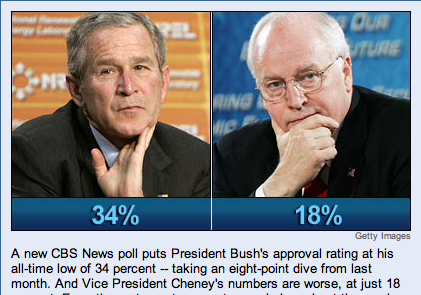
Who are those 34 out of 100 People?


“You can fool some of the people all the time, and those are the ones you want to concentrate on.”

- George W. Bush

"It Didn't Work"


One can't doubt that the American objective in Iraq has failed.
- William F. Buckley

Read the rest of what the Grand Poohbah of American Conservatives now says about Bush's war.

Update 2/28
More from Mr. Buckley: Next Step

Monday, February 27, 2006

The Cost of War

What a Tragedy.

The financial cost of the War in Iraq is nearing $250 billion (that's $250,000,000,000). There are about 26 million souls in Iraq.

Dear reader, with $10,000 to spend for each man, woman, and child in Iraq, could you have found a more effective scheme to solve the problem of an impotent little tinpot dictator named Saddam?

Stated another way, this incredibly stupid, useless, counterproductive war, has cost close to $1000 per each man, woman. and child in America. That cost is not being paid by us, however. It is being passed along for our children to pay. The vast majority of us have continued our daily lives pretty much unaffected by the tremendous (sometimes ultimate) sacrifice of our brave soldiers and their families. While a war rages our President calls for tax cuts. There is something obscene about such a "painless" war.

Think of the possible real security measures $250 billion could have bought, like hunting down the Al Qaeda, securing our ports and our borders, and solidifying our war gains in Afghanistan. Instead we have squandered $250 billion and weakened our security and lost many allies and sullied our honor with torture and compromised our Bill of Rights.

And the cost continues to grow in dollars and national spirit and international prestige and lost years for young American families and mangled bodies and lost lives.

What a tragedy.

What a shame.

Sunday, February 26, 2006

(Minimum) Goal met! MM


Whew! With the wind blowing steadily Sheila and I abandoned the levee after a half mile and hit the downtown streets to gain a little windbreak this Sunday afternoon. 2 miles plus 2 and a half before the rain kept us in a couple of days puts us over the Marathan mark for February. Two months down, ten to go for a marathon year. I'm gonna try to add to the February total and shoot for a signiificant mileage increase in March.

Saturday, February 25, 2006

Here I post. I can do no other.

Defending A Previous Post

[I wrote this post almost three months ago and kind of lost track of it. In light of the sectarian clashes in Iraq this week, the added discord of the "cartoon war", and the continuing insurgency, I think it is perhaps more apropos than when I wrote it.]

I actually am a little unnerved, tacking my theses on a blog for the world to see. It is scary given the fear abroad in our country. I can see some readers seeking to shush me or embarrass me if they think I am un-American, as some would. On the other hand it is nice to be able to express my views with less likelihood that someone will misinterpret my words as personal attacks. They are addressed to the internet. No one can feel that I am forcing my opinions on them: they don't have to read it. It has been good for me to have to research and support my opinions. It has helped me clarify them to myself and I have changed some of my opinions in the process.

Some folks were a little taken aback at a post a while back comparing Bush to McCarthy. I'm not sure that the McCarthy blog was quite ready. But I stand by the basic tenets in it.

The post came about because I looked up McCarthy on the internet when I was researching for an earlier post. I was just dumbfounded by how similar the words of McCarthy and those who supported him were to the people that I think are just as foolishly following the line of the neo-conservatives after the attacks of 2001. Everywhere, the people I admire are called "Anti-American" or Un-American". It is possible we are wrong, I don't think so. But right or wrong we are not anti-American any more than Truman was, or Marshall, or Edward R. Murrow, or the actors, poets, artists, civil-rights workers, union leaders, and others who were smeared as un-American by the McCarthy era right-wing. Michael Moore is not anti-American. He has not always been right, but he loves his country as much as the rest of us. I challenge you to read his words. He wants what he believes is best for America, just as you and I do.

I have virtually no respect for George W. Bush. I believe he sold his soul to become president. I think he is shallow. I think he is horribly mistaken and unwilling to face his own errors. I think he surrounds himself with yes-men and refuses to listen to contrary views. I think he is an insecure man who covers his frailties with bluster and swagger. But I don't accuse him of being anti-American. I have to believe that even that little man loves his country and hopes that his mistaken policies will work out for the best for America.

I think there are very real similarities to the McCarthy era. I remember being terrified of nuclear annihilation as a child. I sometimes had difficulty sleeping. I wondered seriously if I would live to grow up and if there would be a society worth living in if I did. Once Russia got the "Bomb" Americans were very frightened of Communist designs on the world. It was a legitimate fear. There was real war going on, in Korea, during a big part of that time. And the new "Cold War" was even more terrifying in some ways. And there is ample evidence that there were lots of frightened Americans. Nixon used the "Red Scare" to get elected Senator from California. McCarthy used it to stay in power when it looked like the folks in Wisconsin were going to send him home. Then, as now, the biggest fear was the nuclear threat.

I am trying to wrestle with what I believe should be done in Iraq, given the quagmire that Bush has given us. I'm not completely sure yet. I don't think denying the truth helps. I do not believe we should "cut and run". But if the situation has gotten to the point that John Murtha believes we need to leave sooner rather than later, I have to believe that is right. Even our own generals have admitted that our presence fuels the insurgency. There is no legitimate argument that so many terrorists would be in Iraq without us there. I suspect that we should not set a hard and fast schedule of a drawdown but rather a withdrawal plan tied to benchmarks of Iraqi and/or Arab replacements. I suspect we will have to keep "over the horizon" forces available for a longer time. But I am happy for those to the left of me to keep up the pressure on Bush. He has already moved a little. Even he can see the mess we're in, whether he admits it or not. I think the Iraqis need to know that we are leaving and leaving soon. That will force the Iraqis to get ready for self-government and it gives the would-be terrorists less reason to blow themselves up to get us out.

In 1991 Dick Cheney understood the hazards in Iraq:
"I think that the proposition of going to Baghdad is also fallacious. I think if we were going to remove Saddam Hussein we would have had to go all the way to Baghdad, we would have to commit a lot of force because I do not believe he would wait in the Presidential Palace for us to arrive. I think we'd have had to hunt him down. And once we'd done that and we'd gotten rid of Saddam Hussein and his government, then we'd have had to put another government in its place.
What kind of government? Should it be a Sunni government or Shi'i government or a Kurdish government or Ba'athist regime? Or maybe we want to bring in some of the Islamic fundamentalists? How long would we have had to stay in Baghdad to keep that government in place? What would happen to the government once U.S. forces withdrew? How many casualties should the United States accept in that effort to try to create clarity and stability in a situation that is inherently unstable?

I think it is vitally important for a President to know when to use military force. I think it is also very important for him to know when not to commit U.S. military force. And it's my view that the President [Bush 41] got it right both times, that it would have been a mistake for us to get bogged down in the quagmire inside Iraq."
-Dick Cheney, Soref Symposium, 4/29/1991

If you believe the polling, a huge majority of Iraqis want us out and almost half don't blame the insurgents for fighting us. It reminds me of the common refrain among Southern soldiers during the Civil War when Yankees asked them why they were fighting: "Cause y'all are here!" Southerners were far from unified in the desire for secession, but they were almost unanimous in fighting to defend themselves against invaders, even when they agreed with the politics of the invaders. Nobody wants their country overrun by foreign troops even if they speak the same language and have similar customs. Iraq is occupied by soldiers who speak a different language and have repulsive (to them) personal habits and personal morals and who have little or no appreciation or respect for the Iraqi culture and traditions and religion.

I agree with the 1991 Dick Cheney: there is just no good outcome to this mess, and that was obvious, to me, before we went in. I wish Kerry, Clinton, and others had been less supportive than they were. But voting to give a President authority is not quite the same as using that authority prematurely, as he did. And they did not "hype" the war, as he did, by subtly linking Iraq to the 2001 attacks to the extent that a big majority in polls said there was a connection that even Bush admitted there wasn't. Kerry & Co. didn't use discredited "intelligence" to mislead the public, Bush did.

Whenever we leave there will be a period of chaos in Iraq. As Cheney intimated, the Sunnis hate the Shi'ites, the Shi'ites hate the Sunnis and they both hate the Turks, the Kurds, the Jews and the Christians. Minorities in Iraq are in for continued persecution. I certainly wish someone had stopped the Vietnam War sooner. I don't think it could have ended worse, ending sooner.

Our nation will continue, I hope, when we are out of Iraq, whether we leave in 2006 or 2012 or 2018. I hope Iraq will be peaceful then. My primary concern, however, is for what kind of country WE will have. Bush acted foolishly, at best. We need to make sure that this time a lesson is learned, and we stay out of similar messes in the future. We need to rebuild our alliances, restore trust in our government, bring a modicum of unity to our people, and protect ourselves from the new terrorists Bush's policies have created.

----

[You may be interested in reading Sen. John Kerry's opinion of what to do in Iraq from a speech last October.]

Five for Friday


The Friday Five!

1) When does liking someone a lot become loving that person?

As those of you who have known me for a while have no doubt. I have strong opinions on this topic. What an opening.

Love is commitment.

Lust is not Love.
Warm and fuzzy feelings are not Love.
Emotional dependence is not Love.
Admiration is not Love.

To answer the question:

Liking someone a lot becomes love when the two of you make a mutual commitment to love.


I have, of course, waxed eloquently (wink) upon this topic in the past.

2) Is there a job you would do for free, and is it your current job?

Yes and No.
I would (and do, often) act, sing and tell stories for free. I'd love to be able to support my family doing those things.
Although I enjoy teaching and would probably do some educational volunteer work in retirement, I'd love to be able to devote the next few years of my life to acting, singing and storytelling.

3) What is one person/thing that inspired you to take action of some sort?

Erich Fromm, through his book The Art of Loving, inspired me to ask Sheila Matthews out again. There are many other examples, but I'll pick him right now.

4) Though you might not believe in it, would you like fate to exist?

No way. How fatalistic. I have never understood why we humans romanticize fate. Our souls and minds and reason separate us from the amoeba. How much more romantic for a fully conscious, soulful, rational person to choose to join me, of all people, in a lifetime commitment. Wow!

5) What's the kindest thing that anyone has ever done for you?

Sheila's continuing acceptance of me despite my glaring faults and deficiencies.


*****

I discovered The Friday Five through Mike at Musings and Meanderings. Today's questions were right down my alley, as you can see. I enjoy Mike's blog. Check it out.

Thursday, February 23, 2006

TT: 13 Great Posts


Thirteen Great Posts

A hodgepodge of blogs and other web posts that I have found interesting, inspiring, enlightening, or otherwise extraordinary. Check 'em out.
  1. The Questing Parson Visits A Pianist.
  2. Leonard Pitts On The Frightened Right
  3. Ben Witherington On Trading Rights For Security
  4. A Tribute To A Very Special Mother - Mine
  5. 83 Tributes to My Mother
  6. Freedom Of Speech/Respect For Religion
  7. Imagine!
  8. Mike's Memories
  9. Test Your LQ Here (BTW I Flunked)
  10. A Favorite 13 for Thursday
  11. Washington's Pants (Scroll Down)
  12. And Why In the World Do Men's Pants Have Flies? (Scroll Down)
  13. Once people make your story, their story,
    you have tapped into the powerful force of faith.

Get the Thursday Thirteen code here!


The purpose of the meme is to get to know everyone who participates a little bit better every Thursday. Visiting fellow Thirteeners is encouraged! If you participate, leave the link to your Thirteen in others comments. It’s easy, and fun! Be sure to update your Thirteen with links that are left for you, as well! I will link to everyone who participates and leaves a link to their 13 things. Trackbacks, pings, comment links accepted!


Tuesday, February 21, 2006

Four: The Meme

Four
Sister Joan at Daddy's Roses tagged me with this meme. Go over and read hers. Also check out these bloggers who have done this list: Cozy Reader, The Median Sib, Ladybug Crossing, Killired, and Yellow Rose's Garden.

4 + 18 jobs I've had
  1. Shoe polisher and Errand-runner, Grady's Barber Shop, Milstead GA
  2. Bottle collector and Deposit-redeemer, Griffin GA
  3. Lawn mower and weed puller with partner Herbert Leach, Griffin GA
  4. Sacker, Egg-carton-loader, shelf-loader, Red Dot Super Market, Ellijay GA
  5. Sacker, truck-unloader, shelf-loader, cashier at Kroger, Rome GA
  6. Fuller Brush Salesman, Rome GA
  7. Cart-pusher, sweater, Inland Container 2nd Shift, Rome GA
  8. Cookware salesman, Wilmore KY
  9. Library shelver, Asbury College, Wilmore KY
  10. Custodian, Asbury College, Wilmore KY
  11. Cafeteria worker, Asbury College, Wilmore KY
  12. Worst-short-order-cook-in-the-history-of-American-diners, waiter, The Dine-O-Mite, Wilmore KY
  13. Teacher Corps Intern, Putnam County Schools, Bancroft and Liberty WV
  14. Teacher, Assistant Principal, McHenry School, Rome GA
  15. Newspaper publisher, Rome GA
  16. World book Encyclopedia Salesman, Rome GA
  17. Teacher, Pepperell Elementary School, Rome GA
  18. Teacher, Kaleidoscope Gifted Program, Rome GA
  19. Owner/Operator, Shaw LaserPress, Rome GA
  20. Freelance singer, actor, storyteller, Rome GA
  21. Workforce Development Director, Human Development Services, Cave Spring GA
  22. Teacher, Armuchee Elementary School, Rome GA

4 movies I can watch over and over

I love movies! I can watch bad movies a second time just to enjoy criticizing it again. Four just ain't enough. I there challenge authority again and present several categories.

Christmas
  1. It's a Wonderful Life - I've watched it at least once a year for many years.
  2. Miracle on 34th Street - This is not my second favorite flick, but since we also watch it every Christmas it belongs here.
  3. White Christmas - Lil and Bran have watched this video so many times it's a wonder the tape hasn't disintegrated. "Sisters, sisters, there were never such devoted sisters..."
  4. A Christmas Carol
Oldies
  1. Arsenic and Old Lace - It still cracks me up!
  2. The African Queen
  3. The Philadelphia Story
  4. His Girl Friday
Animated
  1. Beauty and the Beast
  2. Mulan
  3. The Lion King
  4. Aladdin
From my adolescence
  1. The Sound of Music
  2. Butch Cassity and the Sundance Kid
  3. Wait Until Dark - I know what's coming and still I jump!
  4. In the Heat of The Night
With Sheila
  1. Star Wars - We sat through it twice at the Desoto the first time we saw it.
  2. Sleepless in Seattle
  3. You've Got Mail
  4. Jaws
Oddball Favs
  1. The Russians Are Coming, The Russians Are Coming
  2. Family Plot
  3. Tales of Manhatten
  4. The Gazebo
Suspense (excluding Wait Until Dark)
  1. The Jagged Edge
  2. Rear Window
  3. North by Northwest
  4. Charade
And I didn't even mention
  1. Casablanca
  2. Shenandoah
  3. Fiddler on the Roof
  4. An American in Paris
Or
  1. When Harry Met Sally
  2. The Conversation
  3. Mr. Holland's Opus
  4. South Pacific
And how could I leave out
  1. The Lord of the Rings (I, II, & III)
  2. Harry Potter (I, II, III & IV, and the three to come)
  3. The Chronicles of Narnia (One down, six to go!)
  4. Anne of Green Gables (I, II, & III)
4 + 9 places I've lived
  1. Milstead GA
  2. Wilmore KY
  3. Duncansville OH (weekends only)
  4. Mackville KY
  5. Junction City KY
  6. Griffin GA
  7. Ellijay GA
  8. Rome GA
  9. Fairburn GA
  10. Huntington WV
  11. Buffalo WV
  12. Eleanor WV
  13. Cave Spring GA (Chubbtown Community)
4 TV shows I love
We went years without access to broadcast or cable TV. During that time we watched many, many videos. There are bunches of shows I love, however, as noted in a previous post. But here are some all time favs:
  1. Andy Griffith
  2. Mary Tyler Moore
  3. All In The Family
  4. Rockford
4 places I've vacationed
One of my regrets is that we have not traveled as much as I would like. But here are my four favorite vacations:
  1. 31 Day Amtrak tour of the US - 1979
  2. Christmas in New York - 2004
  3. Beach vacations with my extended family
  4. Mountain vacations with Sheila's extended family
4 of my favorite dishes
With a very few exceptions, I love food. These are four dishes I love. There are many more!
  1. Booger Hollow Blackberry Cobbler with Ice Cream
  2. Joan's Empress Chili
  3. Mama Shaw's Chili Soup ala Mama ala Sheila
  4. Good bread and cheese with a few nuts from a knapsack by the Pacific after a long walk shared with good friends.
4 blogs I visit daily
  1. - 4. I read my daughters', my sisters' and my mother's blogs every time they post. I check Jane, Andy, Charmaine and Jack almost as often. There are no other blogs I visit every day.
4 places I'd rather be right now
  1. (Censored) ;-)
  2. On stage
  3. Winter Haven FL (with my eldest)
  4. (as long as we're dreaming how about:) Cape San Blas Florida August 8, 1971

Thursday, February 16, 2006

The Secret Garden

Here's a link to a page of pics that I didn't know were there. They are from the production of The Secret Garden 1n 2004.

The Secret Garden