Friday, May 15, 2009

Gleaning Facebook: AES Lifeforms

seven spot ladybug beetle, Coccinella septempunctata
An import from Europe.

ladybird beetle, Coccinella septempunctata


Dryocampa rubicunda - Rosy Maple Moth
My Charlotte brought this guy from home.


Dryocampa rubicunda - Rosy Maple Moth
Moths have antennae that look like feathers, usually. Butterflies have clubbed antennae.


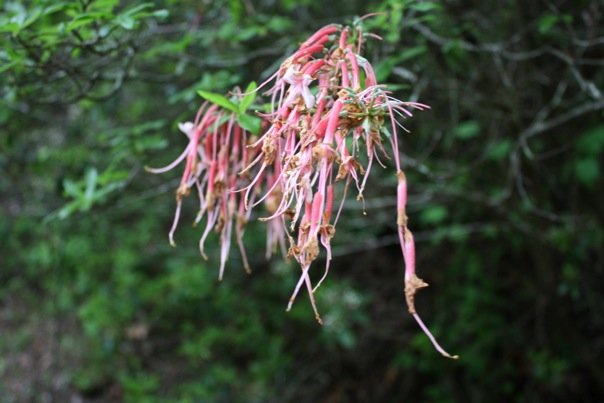
When these buds open they will make one of the oddest, but most gorgeous little flowers you will see.


Turkey Tail Fungus, Trametes versicolor, I think. The same brackett fungus found all over the woods on rotting limbs and logs. See the pine cones? They help you understand the size of this big clump. It is more than a foot in diameter.


I'm 'sposed to know this, but I forget.

Carol Shaw Johnston
We have these flowers all over our woods. Let me know when you figure out what they are.


Gleaning Facebook: Inflatable Day for AES

We are not allowed to upload pics of our students on Facebook.


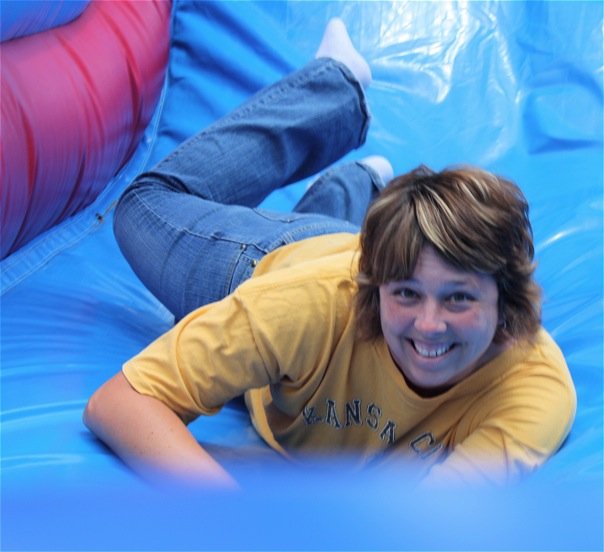
I wish I could show their joyful faces as they celebrated on the inflatable play structures that rose from our school courtyard today.

Here is an elder reveler.
Whee...


...eeeeeeeeeeeeeeeeeeeeeee!


Thursday, May 14, 2009

Gleaning Facebook: Six


Here is a silly Facebook post to share. I posted one word...

... and my fellow teacher and West Rome High School classmate Allice Jeffries Keel was puzzled:

Alice
Pick up sticks? What?

Terrell
Alice, I am a teacher. I have one of the great groups of children of all time. I love my job (except that the powers-that-be have made a foolish decision about next school year that has put a serious damper on my enthusiasm.) But it is that time of year when one can not help but count down. Six.

Alice
Alice goes, "duh!" but we have 10 - I think, plus 2 - that's officially - it's a marathon

Sunday, May 10, 2009

The Flora and Fauna of Nature's Classroom


Here are couple of dozen pics of the Flora and Fauna of Nature's Classroom near Mentone, Alabama on Lookout Mountain. I snapped these last Wednesday, Thursday, and Friday during our annual fourth-grade trip. As one critic has noted I am a little skimpy on Fauna, the bashful beasts.
---------------------

Later---
From my Facebook:
I'm sorry I couldn't catch a shot of the skunk that a few of us watched drift through the cabin circle Thursday night. Here are a few other natural wonders I snapped during our trip to Nature's Classroom. I'll label to the best of my ability and edit as my more botanically or zoologically astute friends nudge me.

Tony Pope
Is this bull thistle? You know that's what they (the Cherokee) use to make the "fuzzy" part of their blow darts.
Terrell
Yes, Tony. I learned that from Steve McCarty who does such a great weapons demonstration for our fourth-graders every year at Etowah Mounds.

Lichen


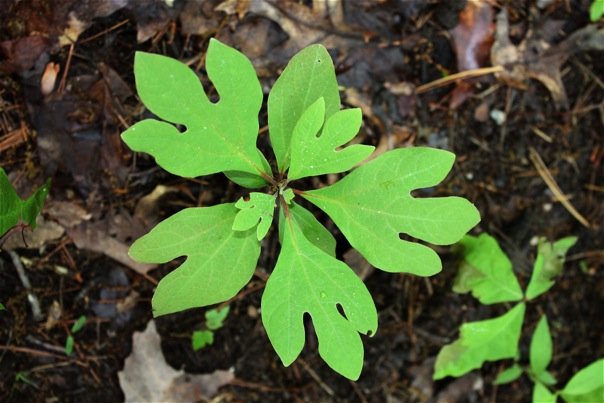
Sassafras 
Sassafras albidum 
You can see the three leaf-types of Sassafras - pitchfork, mitten, and spade. Sassafras roots are used to flavor many things, including root beer and medicines. The cleaned roots boiled with a little sugar make Sassafras tea.

Whorled Loosestrife 
Lysimachia quadrifolia


Lots of these deerberries or blueberries or huckleberries or whatever were blooming. I suppose this is a vaccinium species. I'm guessing Vaccinium stamineum, Deerberry.

Vaccinium stamineum, Deerberry

Maple-leaf Viburnum, 
Viburnum acerifolium

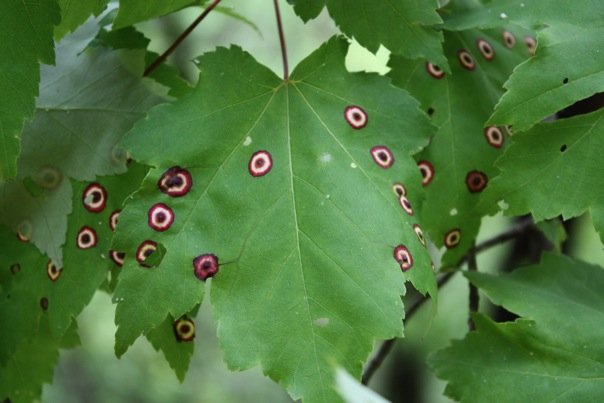
The parasite responsible for this particular gall is the maggot larvae of the ocellate (or maple eyespot) gall midge. The bull's eye is formed by substances secreted by these maggots. Once they mature they'll drop to the ground below and burrow into the soil where they'll eventually rise as adults. 
http://naturejournals.blogspot.com/.../maple-eyespot-gall... 
Maple Eyespot Galls Recently Spotted 
The maple eyespot gall midge, Acericecis ocellaris, is also called the maple leafspot gall midge. The word ocellaris comes from the Latin word ocellus meaning eye (hence the name eyespot gall). An official common name does not exist for this insect. Maple eyespot gall midges emerge in early spring and lay their eggs on the newly-expanding leaves. As the maggots hatch and feed on the tender leaf growth, they secrete substances which cause the leaves to form dimples around the maggots (resulting in striking yellow and red circles around the gall). The maggots soon mature and drop to the soil surface where they evidently dig into the soil to spend the rest of the summer, fall and winter. Another generation of midges will emerge the next year. Insect populations vary from year to year due to weather, predation, diseases and additional factors; thus, the maple eyespot galls may be much less noticeable next year. Because they do negligible damage, their management is not necessary. 
http://ipm.ncsu.edu/curr.../98PestNews/98News3/ornament.html

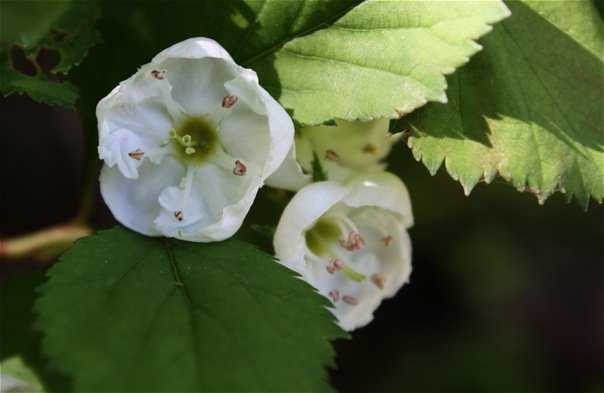
Hawthorn 
Crataegus spp

Hawthorn 
Crataegus spp

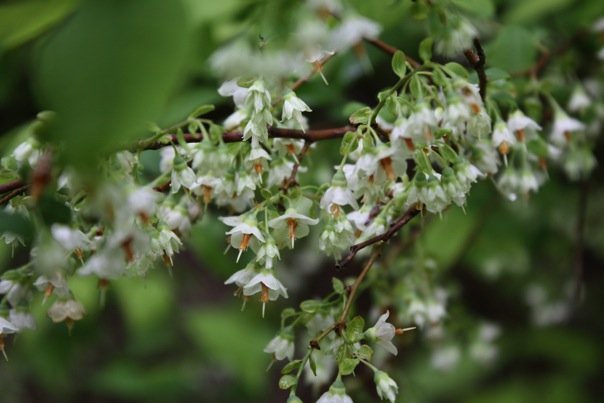
Granny Graybeard 
or Fringe tree 
Chionanthus virginicus

Hawthorn 
Crataegus spp

Hawthorn 
Crataegus spp

DYC 
"D@*# Yellow Composite"

Rhododendron sp.

Rhododendron sp.

Mountain Laurel 
Kalmia latifolia 

Galax
Galax urceolata

I suppose this could be the same one we have on our campus at Armuchee:
Piedmont Azalea 
Rhododendron canescens?

Vaccinium stamineum, Deerberry 


A different Vaccinium species? Or just closer to fruiting?

Centipede in the shower. Centi shouldn't do that.
This looks like a "House Centipede"
Scutigera coleoptrata 
Wikipedia says: "
Scutigera coleoptrata (one of several species commonly known as the house centipede), is a yellowish-grey centipede with 15 pairs of legs. Originally endemic to the Mediterranean region, the species has spread to other parts of the world, where it usually lives in human homes. It is an insectivore; it kills and eats arthropods such as insects and arachnids
S. coleoptrata is 25 mm (0.98 in) to 50 mm (2.0 in) in length and has up to 15 pairs of remarkably long legs. These delicate legs are attached to a rigid body. This enables it to reach surprising speeds of up to 406 mm (16.0 in) per second[1] running across floors, up walls and along ceilings. Its body is yellowish-grey and has three dark-colored dorsal stripes running down its length; the legs also have dark stripes. Unlike most other centipedes, house centipedes and their close relatives have well-developed, faceted eyes. S. coleoptrata has developed automimicry in that its hind legs present the appearance of antennae. While it is at rest it is not easy to tell its front from its back."
http://en.wikipedia.org/wiki/Scutigera_coleoptrata


Eumeces fasciatus 
Five-lined Skink

There are three Five-lined Skinks in the southeast. I'll guess this one.


Bluets (Quaker Ladies)

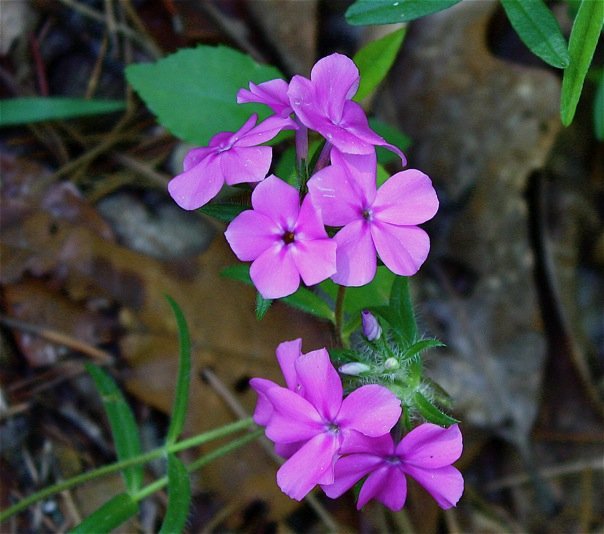
Phlox

Fence Lizard


Indian Physic
Gillenia trifoliata


Sweet Shrub


Saturday, May 02, 2009

Gleaning Facebook: Back to Camp


That's me on the biplane; I don't remember which year this was.


Lazy weekend. Busy week -- the highlight of the year -- coming... to camp with 150 fourth-graders and parents for three days. Many of these kids were born the year I took the first group to camp ten years ago. Canoeing, exploring the woods and streams, zip line, Ort Report, "Underground Railroad", and much more...

------------

Comments

Tammy DeHart
Chris is looking forward to it....as is CJ, I just hope she doesn't chicken out of some stuff.


Terrell Shaw
CJ and Carson will have a ball! (So will Chris. And Traci knows.)


Susan Cherones
Sounds great! Don't tell me it's been 10 years since you came to ExperienceWorks!!!


Terrell Shaw
I 'spose I should say this is my tenth trip... the first was in May of 2000. Nancy and I brought 15 boys to Lookout Mountain Camp for Boys where I first witnessed Susan Cherones knocking down a wall! The next year we took two classes. The next all fourth grades went along and we stayed with that great bunch from Experinece Works for a total of six years. This will be our fourth year at Nature's Classroom (since y'all gave it up.)
It is a great experience for our students and one that they never forget. Thank you and Ellen and Nancy for getting us going. It is a wonderful tradition.


Ellen K. Thompson
Wonderful memories!!! (-; Terrell, do you still do that echo thing with a kid on Skit Night? (-; And, I will NEVER forget the first group of boys y'all brought to ExperienceWorks!! Wow......enough said.....


Terrell Shaw
Now, Ellen, you know that sound is one of our major units of study in fourth grade science. So I have to take advantage of the unique acoustical characteristics of that building at camp! It is a wonderful opportunity to review sound reflection. I know it is unusual to insert such a serious science lesson into the silliness of Skit Night, but our first obligation is to the Georgia Performance Standards. And I am always ready to ... perform.

Friday, May 01, 2009

Gleaning Facebook: Corn Snake


Quiet fall morning at Arrowhead... till the second-graders get here, anyway.


Allien McNair: Wow, talk about relief. When I saw you had posted a picture from this week I was scared of what you had put up. Thank goodness it was just my hands and my snake!! 
Thanks Terrell.

Tammy DeHart: I am surprised CJ didnt go into shock!

Alice Jeffries Keel: I had a temporary grandsnake this week - named Grady. He is a worm snake. I think he is going home to his "mama" today. But Arrowhead Corn sssssnake is beautiful!

Terrell Shaw: Allien, don't relax yet. I may decide to post a pic of your courtyard dance... ðŸ™‚
Thanks for commenting Alissssssssse. ðŸ™‚ The snake has one parent that is an albino, I thot that might explain the coloring. But a google images search shows corn snakes have very variable coloration. They are definitely colorful snakes!!