Showing posts with label John Adams. Show all posts

Thursday, January 04, 2007

No religious test...

(One reader seemed to misunderstand part of this post so I have edited it slightly to be better understood. By the way, my outgoing e-mail is still not working, dang it! I know it's just some little setting that's different on this machine.)
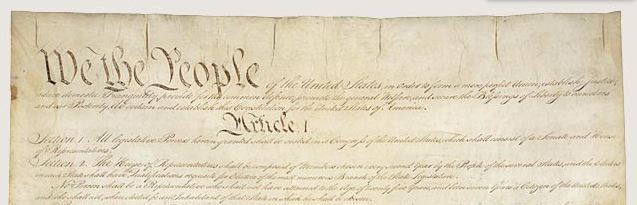
From the Constitution of the United States:
The Senators and Representatives before mentioned, and the members of the several State Legislatures, and all executive and judicial officers, both of the United States and of the several States, shall be bound by oath or affirmation to support this Constitution; but no religious test shall ever be required as a qualification to any office, or public trust, under the United States.

That text is very clear and absolute. Any Congressman who tries to institute a religious test for a Member of Congress has broken his oath: He is NOT defending, protecting, supporting the Constitution.
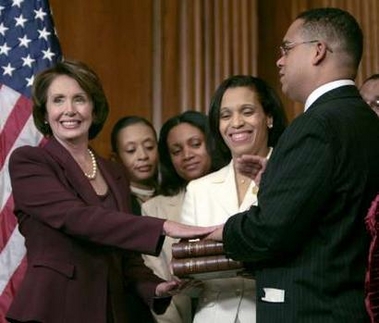

Congressman Keith Ellison, our first Muslim Member of Congress
I congratulate him and wish him well.


My Median Sib, today, a remarkable woman; a loving wife, daughter, mother, and grandmother; and an honored teacher, and a person I respect and love and welcome to rebut what I write here, has, it seems to me in my anything-but-humble opinion, leapt off a cliff, gone off the deep end, climbed out of the pot and into the fire, [fill in your own cliche for "failed to wisely agree with her loving older and wiser brother"]. In reaction to the election of our first Muslim Member of Congress, she has written:
"Muslims worldwide have declared jihad on the United States and ANYONE who is not Muslim. I think it was a mistake to elect an “enemy” to Congress."
I cannot express how saddened I am by that unfortunate statement. And I cannot let it pass without comment.

My Sib's post seems to consider Congressman Keith Ellison an “enemy” simply because he is Muslim. If so, that is an affront to many wonderful loyal Americans, including some of my favorite students and their fine parents and one of the finest co-workers I have (an Iraqi-American Kurd whose brother was murdered by Saddam and who fled Iraq with her husband and children to escape some of the same terrorists that my Sib seems to be lumping her with). It would certainly be an affront to our Muslim-American soldiers past and present.

Would we force a member to be sworn on the Bible when that is not his Book of Faith? Wouldn’t that require him to be hypocritical? Isn't that a "religious test"? Does the Constitution preclude non-Christians from serving in Congress? Should we take away citizenship from those of other faiths?

I am not a Muslim. I am sure there is much to admire in their faith, but I happen to think it contains a lot of hogwash. I also think some elements of Catholicism are largely hogwash. (The saint "worship", the ridiculous veneration of a bit of bone or cloth as a holy relic, pilgrimages to venerate a cookie that vaguely resembles somebody’s idea of what Mary looked like.) And Mormonism, Lord have mercy! Shoot, I’m a Methodist, and I know there are some radical and ridiculous Methodists, too.

Still, I find much to admire in some Mormons, Catholics, and Muslims. Democratic Senator Harry Reid and Republican Senator Orrin Hatch are Mormons -- Do they really believe in Joseph Smith’s golden tablets? And does that strange belief preclude them from office? If Hatch or Reid want to use the Book of Mormon (I know they also claim the Bible) as the Book of Faith that they use for their swearing-in ceremonies, that’s fine with me.

I just want them to mean it when they say:
“I do solemnly swear that I will support and defend the Constitution of the United States against all enemies, foreign and domestic; that I will bear true faith and allegiance to the same; that I take this obligation freely, without any mental reservation or purpose of evasion, and that I will well and faithfully discharge the duties of the office on which I am about to enter, so help me God.”
Until the Civil War, when Yankee Congressmen were concerned about domestic rebels, the original oath was used:
“I do solemnly swear (or affirm) that I will support the Constitution of the United States.”
That’s simple and to the point, though I like the addition of “defend”: the first duty of a member of Congress is to support and defend the Constitution.

You will note that Madison, et al, neglected to add “so help me God” to the Presidential oath written into the Constitution. They were determined that ours was to be a secular government, as they later specifically pointed out to the Muslim Barbary pirates. The following is part of the treaty read and approved unanimously in the Senate on June 7, 1797. President John Adams, a devout Christian, signed it and proclaimed it to the Nation.
"Art. 11. As the Government of the United States of America is not, in any sense, founded on the Christian religion; as it has in itself no character of enmity against the laws, religion, or tranquillity, of Mussulmen [Muslims]; and, as the said States never entered into any war, or act of hostility against any Mahometan [Islamic] nation, it is declared by the parties, that no pretext arising from religious opinions, shall ever produce an interruption of the harmony existing between the two countries."

The recounting of the evils of the Islamic governments elsewhere in the world, of course, begs the question and has no legitimate relevance to how we should interpret our Constitution.

I will stand shoulder to shoulder with anyone to oppose any Muslim who tries to restrict any American's freedom of religion or speech or any other Constitutional right. But I will also stand with Congressman Ellison, or my co-worker, or my students, against anyone who tries to limit their religious rights.

I know this question sounds harsh, -- no one should take it as a personal shot -- I mean it as beginning point for an honest dialogue: How can we restrict religious speech or non-violent religious practice [that is, disallow the use of the Koran for a swearing-in ceremony] and still support and defend the Constitution of the United States? Such restriction, in my book, is counter to the Constitution and therefore quintessentially un-American.

I absolutely welcome polite debate about this issue.

1-05-07 Note: The Median Sib has written a post to clarify the post that I have responded to here. I won't try to characterize it or comment on it except to invite my readers to visit her blog to better understand her position on the issue of Keith Ellison's election, his use of the Koran, and other things.


Here is a previous post on the separation of church and state.

Wednesday, March 22, 2006

Welcome to the Limb, Mike Bock!

The Limb is a little less lonely today: Mike Bock, a kindred spirit and friend since our college days, has agreed to be a regular guest writer. His first independent post here deals with his opinions about the need for character development in students, inspired by his reading of David McCullough's John Adams.

This is not Mike's first post here, though. Here are the other posts he has written that I have borrowed for the Limb, as well as a longish comment on one of my posts:

The Education Of John Adams

The Education Of John Adams

David McCullough’s book, John Adams, tells about the education of John Adams.

John Adams graduated from Harvard, received a law degree, acquired academic recognition, read Cicero and the classics, was immersed in life-long learning. What distinguished John Adams most, however, was not his learning accomplishments; what distinguished John Adams was his overall character, his: integrity, commitment to truth and justice, dedication to service, commitment to personal excellence, inner self-reflection, personal courage, etc. The education of John Adams involved the mastery of academics, but, the more important part of his education was the development and strengthening of his character.

The development and strengthening of character is a vital part of what it means to become a fully realized person. Character development is an important part of an effective education. But since character development is not something that evaluators of a school measure, character development is now effectively ignored by schools. Academic growth is what is emphasized. Evaluators periodically want to know: Has there been sufficient growth in the children's reading, writing and math progress? Has there been growth in the children’s test taking skills? The merit of a school is determined according to the findings of such evaluations. The importance of character development may be mentioned in school publications as a vague goal, but, practically, because character development is not part of school evaluations, schools ignore character development.

If a real goal of schools was to promote character growth in children, then schools would be evaluated not just on academic growth, but on character growth as well. Evaluators periodically would want to know the answers to such questions as: Has there been any positive growth in the children's integrity, commitment to truth? Any growth in the children's inclination to question authority, to think independently? Any growth in the children's commitment to personal excellence or inner self-reflection? And schools would be evaluated and ranked according to the evaluators’ findings of such questions.

The purpose for public schools has become lost.

The purpose for public schools that makes most sense to me is that public schools should provide an education to its citizens that will empower and encourage them to participate effectively in their democracy. The public good in public education of most importance, it seems to me, is the development of a citizenry with the personal qualities, with the character, needed to assure the preservation and growth of our democracy, the preservation of a government, "for the people, by the people."

Schools, generally, do not model for students what democracy should be, but, rather, immerse students into a benign or petty dictatorship -- an overall organizational structure that is the hallmark of most schools. Schools convince students, by much reinforcement over the years, that when one obeys and fawns over authority, one receives rewards and when one defies authority, one receives punishment. Structures of control that may seem appropriate to guide the behavior of 6 or 7 year olds, continue to be used by schools to control 16 or 17 year olds. Schools, through their practices, engage in enforcing immaturity within their students. Students are not encouraged to develop the character of John Adams, but, in fact, are often punished for displaying independent thinking that challenges authority or for showing a commitment to personal integrity. The idea that schools should prepare students for effective citizenry has become a forgotten idea.

Most of John Adams' early character development occurred outside of his formal schooling. McCullough shows that Adams’ parents played a big role in his development. One central quality that Adams continually credited to his father was his high standard for honesty, and, it is apparent that his parents' character proved to be an inspiration and model for Adams throughout his entire life.

The other huge early educational influence on John Adams, that impacted his character development, was simply his overall environment. By his report, he lived a wonderful childhood, surrounded by a supportive, vital community. Not only his immediate family, but, his whole community contributed to his happy development. "It takes a village," is a powerful concept, the application of which can positively be seen in Adams' early life.

If a childhood such as Adams enjoyed, with the influence of such positive parents and community, could be every child's birthright, then the matter of schools providing the education needed for effective citizenry would not be a concern. Students would acquire the tools for effective citizenry, like Adams, outside of their formal schooling. But, few children are so privileged as Adams was privileged. And the issue is not only money. Regardless that their personal comfort/affluence is probably much higher than what Adams experienced in his childhood, by the standard of Adams' childhood, most children today are deprived. Children today often lack the attention and care of wise, grounded parents; they lack the interactions of a vital community. Rather, children are immersed in a media culture and in media values; the TV often serves both as parents and community.

The deprivation of children that schools most note is the deprivation that will get the schools in most trouble in state evaluations. But, the most important deprivation of students is not their lack of a foundation in math or writing skills. The deprivation of children that is most important is their lack of good role models, their lack of the support of a vital community, their lack of practical and real experiences. It is these deprivations that most hinder the development of character in children. How schools can effectively compensate for these more important deprivations of children is a key question.

Schools make a mistake by not recognizing the importance of the developing and strengthening character within students. Character development is actually the cornerstone of education. Character development goes hand in hand with academic development. We cannot, try as we may, divide humans into distinct compartments. The early education of John Adams resulted in his becoming a man of great learning, and a man of great character. Learning helped improve and strengthen John Adams’ character, and a strengthened character helped Adams to be a better learner. This relation between learning and character seems a great principle that could be applied to much advantage in schools.

And so, how can character be developed in schools? Certainly not through dictatorial efforts nor through workbooks or classes. It seems to me that the question of how student character can be developed and strengthened in schools requires an answer, in fact, that goes beyond what is imaginable for schools as they are currently structured. But whatever the answer is, the first step is to acknowlege the importance of character development and to make a commitment to finding ways to make character development a central concern of schools. John Adams' biography reveals principles of character development. Principles endure. The challenge is to use principles to guide the design of new educational structures, new schools -- but that is a challenge for another day.

It is an interesting question: what would educational structures/schools look like that would implement and use the principles that were the basis for the education of John Adams?

Thursday, March 16, 2006

Guest Post: Were the Quakers Right?

Weren’t The Quakers Right?

Note from the Limb: You are about to read a provocative post. My good friend, Mike Bock, has been carrying on an e-mail conversation with a friend about their reactions to David McCullough's biography of John Adams. This post was born of that conversation. As someone who has revered the founders of the American republic, it is difficult for me to even consider that Washington, Jefferson, Adams, and Franklin, et al, may have been mistaken and that world history since might have been just as free and more peaceful had the Quakers' pacifism prevailed in the 1770s. It is an interesting discussion though, and so, despite a little discomfort at the thought, I am pleased to give Mike this forum to explore his ideas. Whadya'll think?

Was the Revolutionary War justified? I read in David McCullough’s book on John Adams that the Quakers opposed the Revolutionary War, an opposition based upon the Quakers’ understanding of the principle of Christian pacifism. I must have previously heard that fact, but, before now, I’ve never really thought about the implications of the Quaker opposition to the Revolutionary War.

We are brainwashed from childhood, of course, to believe that the Revolutionary War was a war of virtue; by implication or by outright teaching the message about the beginnings of our country is that the Revolutionary War, by founding a Christian nation, was a war pleasing to God. But the Quakers say: No. The Quakers have always said: No to War. The history of man is that violence begets violence, war leads to more war. The American Revolution, in a very important way, served as a bad example to history. Violence -- in the name of liberty, equality, etc. -- via the American Revolution, was given legitimacy/moral approval and this approval has helped to spawn and to legitimize violence throughout the entire world, up to and including this time.

Didn’t the Quakers, in opposing the Revolutionary War, advocate a position more in keeping with the teachings of Christ than the position advocated by individuals such as Adams or Jefferson? It seems to me that the thesis could be developed that The Revolutionary War, a war that gained popular support via persuasive propaganda such as Common Sense, etc., and gained support via the advocacy of highly regarded thinkers such as John Adams, was, in fact, a war of choice. How could the act of choosing to pursue war, an unnecessary war, be defended as in keeping with the teachings of Christ? Of course, the key word is “unnecessary” and the point that war is unnecessary is never a point granted by the propagandists -- of the Revolutionary War or of any war. Rather, propagandists convince people of the urgency/need for war, because war is presented as demanded by circumstances, as impossible to avoid, etc. But as it turns out, and history shows, the Revolutionary War, in fact, was not necessary. The arc of history that produced a democratic Canada and Australia would also, in time, certainly have produced a democratic United States. And, it is interesting to consider, if the United States would have been created through nonviolence, and if the principles of nonviolence, early in our history, would have been instilled as part of our national character, how spectacularly improved would the world be today?

The fact that there were devout Christians -- Quakers -- who, in response to their Christianity, opposed the Revolutionary War is a fact that is often overlooked in our history textbooks. As a country, we want to believe that God sanctioned the Revolutionary War, and we want to believe that God sanctions our current war. Our textbooks, opinion pages and TV news/commentaries disseminate information that assists in persuading us of the belief that as a nation we are, “under God.” We have the picture of George Washington, at Valley Forge, praying over the falling snow, as part of our national mythology. And we connect that iconic image of Washington praying with the image of George W. Bush, looking pious, at a prayer breakfast, praying. As a country, we want to convince ourselves that God is on our side.

But, as I heard in a sermon once, the question we should ask is not if God is on our side, but, we should ask if we are on God’s side. What is interesting is that there are many people who identify themselves as Christians who reject the idea that one of God’s principles, as revealed by Christ, is the principle of pacifism. It is interesting that today many people who identify themselves as Christians claim that God’s principles actually sanction war and violence. Of course, throughout history, people who have identified themselves as Christians have also claimed that God’s principles have sanctioned such things as: the Crusades, the Inquisition, the burning of infidels, and the institution of slavery. So there is ample historical evidence that people who call themselves Christians have been spectacularly wrong in their understanding of what Christianity should be all about, wrong about what the message of Christ is all about, wrong about what God’s principles are. I am wondering if it is possible that we are entering an era when many Christians will experience a revelation that they are spectacularly wrong about the issues of peace and war and that this revelation will be the basis for a genuine Christian peace movement within our nation?

The Quakers, during the Revolutionary War, were persecuted for their conviction that pacifism is God’s principle. And the Quakers, regardless of persecution, stood by their principles. Shouldn’t we learn from the Quakers? Weren’t the Quakers right then? And, aren’t the Quakers right even now?